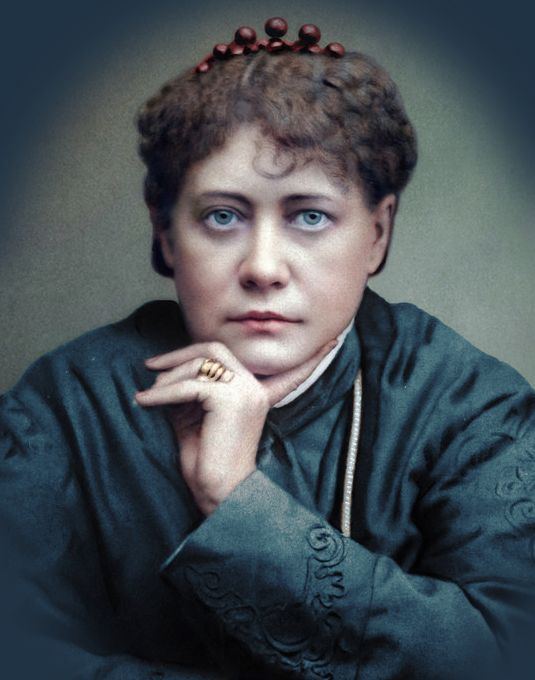
Co-founder of the Theosophical Society. The Secret Doctrine, and the bridge to the East.
theosophyeasternoccultcosmology
Helena Petrovna Blavatsky was born in Ukraine in 1831 and spent her life traveling: India, Tibet, Egypt, the Americas. In 1875 she co-founded the Theosophical Society in New York with Henry Steel Olcott, opening the modern dialogue between Western esotericism and the dharmic traditions of the East.
Her two major works, Isis Unveiled (1877) and The Secret Doctrine (1888), drew the Western seeker into the Stanzas of Dzyan and the wisdom of the Mahatmas she claimed as teachers. She was vilified in her time and read for the next century.
Without Blavatsky, almost none of what we now call the Western esoteric revival would exist. She is the great bridge.
Blavatsky's magnum opus, published in 1888. Volume One presents the cosmogenesis: how the universe arose out of the Absolute, the sevenfold structure of the worlds, the great rounds and races of cosmic evolution, and a long commentary on the Stanzas of Dzyan, an archaic text she claimed to translate from a Senzar original. The book sits at the foundation of every later theosophical and esoteric writer who took her work seriously, from Hall to Steiner to the modern New Age.
Dr. Athena's note A book to live with for a year, not read in a week. Begin with the Proem. Sit with the Stanzas. The commentary is a key, not the door itself.
Volume Two turns from cosmos to humanity. Blavatsky lays out the doctrine of the great races, the long descent of the spirit into matter and its slow ascent again, the meaning of the Fall in its esoteric reading, the symbolic language of the world myths, and the place of the individual human soul inside this enormous evolutionary arc. The most controversial volume of the work and also the most far-reaching.
Dr. Athena's note Read Volume One first; this one assumes the framework. The race doctrine here is best read symbolically, not literally, Blavatsky is describing states of consciousness embodied across long ages.
A posthumous compilation, edited by Annie Besant from Blavatsky's remaining papers and from the private esoteric instructions she gave to her inner-section students. Where Volumes One and Two laid the public theosophical foundation, this volume is closer to a working manual: notes on the inner constitution of man, the meaning of the sacred syllables, the practice of meditation, and clarifications of points left enigmatic in the earlier volumes.
Dr. Athena's note The most practical of the three volumes. Treat it as Blavatsky's teaching notebook rather than her finished theology.
Blavatsky's first great work, published in 1877. Two volumes, Science and Theology, that survey the entire field of the Western and Eastern occult traditions and argue that the ancient mysteries, the Hermetic schools, the medieval alchemists, and the great Eastern wisdom traditions all preserve fragments of a single primordial revelation. The book that launched the Theosophical Society and put theosophy on the modern intellectual map.
Dr. Athena's note Earlier than *The Secret Doctrine* and broader, less structured. Read it for the survey of the field and for the polemical fire of a young teacher who has just seen something the world has forgotten.
A patient introduction to the entire theosophical teaching, written in question-and-answer form between an inquirer and a teacher. Blavatsky walks the reader through the sevenfold constitution of man, karma and reincarnation, the after-death states, the practical ethics of the theosophical life, and the function of the Theosophical Society itself. The clearest single doorway into her thought.
Dr. Athena's note Start here if you are new to Blavatsky. The dialogue form makes the hard ideas absorbable, and the questions are the ones any honest reader actually asks.
A small book of devotional fragments that Blavatsky said she translated from an ancient Mahayana text used to train inner disciples. Three short treatises: The Voice of the Silence, The Two Paths, and The Seven Portals. Compact, lyrical, written for the heart rather than the intellect, and the most quoted of all her works in later esoteric literature.
Dr. Athena's note Carry it. Read a paragraph before you sit. The book was written to be lived, not studied.
A collection of Blavatsky's shorter essays and articles drawn from her years editing *Lucifer* and *The Theosophist*. Short pieces on practical occultism, the dangers of false practice, the inner meaning of psychic phenomena, the distinction between the magician and the medium, the nature of the elementals, and the ethics that must accompany any opening of inner faculties. A useful supplement for readers who want her more direct teaching voice without the architecture of the great folios.
Dr. Athena's note Blavatsky was a working journalist as well as a doctrinal author. These short pieces show the teacher at her quickest and least systematic, sometimes the most direct way in.
An eight-week guided reading of *The Key to Theosophy* with weekly discussion notes, practice prompts, and study questions. Designed for the new reader who wants to walk through the doorway of Blavatsky's thought rather than wander it alone.